
Naming and branding an office building: a 6-step method
An office building is often marketed off-plan, or during a construction phase that lasts several years. Future occupiers and investors then have to picture themselves in a place that does not exist yet. A name and a brand give them an image of it: they tell the story of the place, its neighbourhood, its architecture and its services, and set it apart from the other offers on the market.
Since 2002, Iceberg has created the identity of office buildings for investors, property companies and developers: HOPEN and Altiplano in La Défense, Kennedy and 26 Madrid in Paris, Botanica in Luxembourg. Here is our method, step by step.
Why give a building a brand?
An address is rarely enough to stand out. In the same neighbourhood, several new or refurbished buildings compete for the same companies, with comparable floor areas and certifications. The brand brings what the technical specification does not say: an intention, a way of working, a story.
It also helps to turn the page. When a building is fully refurbished, a new name signals that the place has changed. In La Défense, the former Adria tower became HOPEN; the former PB10 building, built in 1982, became Altiplano.
Step 1: understand the project and its market
Everything starts with an immersion in the project: the programme, the architecture, the services, the history of the site and the neighbourhood. We then identify the audiences to convince. Occupiers are looking for a place their teams will want to come to. Brokers need clear arguments to pass on. Investors look at the value and long-term potential of the asset.
Finally, an analysis of competing buildings shows what is already being said on the market, and therefore what will allow the project to stand out.
Step 2: define the brand territory
The brand territory sets the positioning and the story of the place, in one simple idea that every medium will carry. For Botanica, in Luxembourg, the idea is working in the heart of a park, with the services of a real place to live. For Altiplano, it is a demanding environmental approach, made desirable. For Carré Concorde, two private mansions from 1768 renovated as offices, it is the “Intemporelle Modernité” (Timeless Modernity) concept.
Step 3: find the name
Two families of names are open to the project.
- The address name uses the street, the number or the neighbourhood: 26 Madrid, 52 Champs-Élysées, Kennedy. It reassures and anchors the building in a well-known place. It suits prestigious addresses in central Paris.
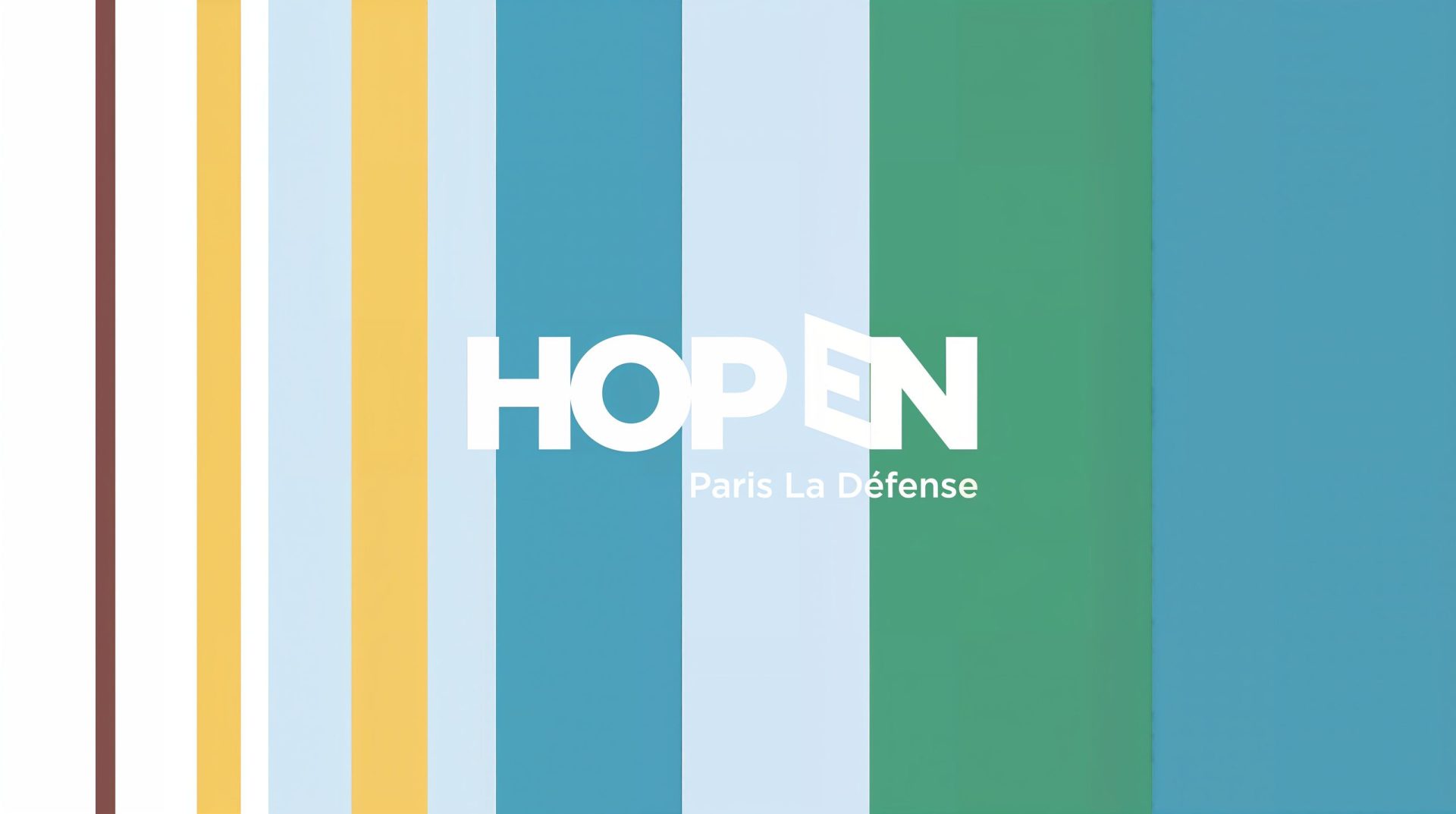
- The created name carries an idea. HOPEN combines hope and open, for a tower that opens onto the city. Botanica immediately announces a project organised around a park.
A good name is easy to pronounce in both French and English, is memorable and does not resemble that of a neighbouring building. It must not depend on a future tenant. Before it is approved, a lawyer checks that it is available, through a prior-rights search with the INPI (the French intellectual property office) and the EUIPO, in particular for real estate services. You also need to make sure that the domain name and the social media accounts are free.
Step 4: write the tagline
The tagline completes the name in one sentence. It states the promise of the place:
- “Your office resort” for Botanica;
- “Régénérer Paris, au rythme de la Seine” (Regenerating Paris, in step with the Seine) for Kennedy;
- “Paris VIII, la signature d’une adresse” (Paris VIII, the signature of an address) for 26 Madrid;
- “La Poste du Louvre ouvre son cœur à Paris” (La Poste du Louvre opens its heart to Paris) for La Poste du Louvre.
The tagline then serves as the starting point for the campaign. For Kennedy, the construction hoardings carried the message “Le 16ème a changé. Et vous ?” (The 16th has changed. Have you?). For La Poste du Louvre, the tagline opened a gallery of portraits of the future occupants, a campaign that won the COM-ENT d’Or for brand creation and the TOP/COM award.
Step 5: create the visual identity
The logo, colours, typefaces and image style translate the brand territory. HOPEN’s colourful, lively universe features characters stepping through coloured doors, an image of a tower open to all. Carré Concorde combines a monogram and gold geometric patterns, between neoclassical refinement and contemporary design.
When the building is still under construction, the image must help people imagine the future life of the place. For Altiplano, Iceberg staged a stag, an elephant, a whale or a dancer on the bare floors. 3D renderings and visuals created with artificial intelligence also make it possible to show the spaces before delivery. See our Real estate film and 3D page.
Step 6: roll out the brand across the marketing materials
The brand then lives on every medium, from the construction site to the viewings:
- construction hoardings, building wraps and posters;
- brochure, box set and publications for brokers and investors;
- website, film and 3D, social media;
- marketing suite, show floor and welcome kit for viewings;
- launch event for brokers.
The same team oversees this roll-out, which keeps everything consistent. The full range of materials is on our Real estate communication and Real estate marketing suite pages. To choose the viewing space, see our guide Marketing suite or showroom.
What a brand changes for leasing
A brand does not lease a building on its own: location, price and the quality of the spaces remain decisive. But it helps the building get noticed and convey an intention. Delivered in 2024, Altiplano was nearly 90% let before delivery, to Suez and Enedis, which are setting up their headquarters there. At 26 rue de Madrid, the building has found a tenant.
Frequently asked questions
When should a building’s brand be created?
As early as possible. The brand often accompanies the project from the start of construction, with the hoardings and the first materials, well before delivery.
How long does it take to create a building’s brand?
Generally between two and three months for the name, the tagline and the visual identity.
Should you keep the address name?
Not necessarily. An address name suits prestigious, well-known locations. A created name is more useful when the building needs to change its image, when the address says little, or when the project brings together several buildings.
Can you rename an existing building?
Yes, especially during a major refurbishment. The new name shows that the building has been transformed, like the former Adria tower in La Défense, which became HOPEN.
Does the name have to be in English?
No. Above all, it must be easy to say and remember for all its audiences. Names that work in both languages, such as HOPEN or Botanica, are valuable for buildings aimed at international companies.
Preparing to market a building? Discover our approach to real estate branding, or let’s talk about your project: yulia@iceberg.fr – +33 6 64 86 93 83.
115 rue du bac
75007 Paris - France
Aspin Commercial Tower, 41st Floor,
Office 4101-4104 Sheikh Zayed Road
P.O Box 72461, Dubai, U.A.E
- A Senior Project Manager
- An Art Director
- A Senior Graphic Designer / Creative
- A 3D Generalist
- A Web Developer
- A Community Manager (freelance)
- Interns: graphic design, project management, business development
+ 33 1 85 61 09 36
+ 33 1 85 61 09 36
+ 33 1 85 61 09 36
yulia@iceberg.fr
Contact Dubaï :
T. + 33 6 64 86 93 83
yulia@iceberg.fr

ICEBERG – LLC (Limited Liability Company - fifty thousand euros of capital)
RCS Paris B441 182 003
SIRET : 441 182 003 00034
115, rue du Bac - 75007 Paris
+33 (0)6 64 86 93 83
ice.info@iceberg.fr
Creation :
Iceberg.fr
Publication manager :
ICEBERG
115, rue du Bac - 75007 Paris
+33 (0)6 64 86 93 83
ice.info@iceberg.fr
Hosting :
SAS OVH
2, rue Kellermann - 59 100 ROUBAIX, France
+33 (0)8 99 70 17 61