
Luxury packaging: designing the box and gift set for a fragrance or skincare product
In perfumery, packaging is often the first contact between a house and its customer. Before smelling the fragrance, you see the box, pick it up and open it. For a luxury brand, this object must convey at a glance its history, its standards and its value.
Iceberg designs packaging, gift sets and their staging for luxury, fragrance and beauty houses: the gift set for Initio Parfums Privés, the wooden box for Veuve Clicquot, the skincare jar for Dior, the twelve skincare products of Maison Françoise Morice, the packaging for the Hydrafacial x JLo Beauty collaboration. Here are the choices that make successful luxury packaging, and how a project unfolds.
Bottle, box, gift set: what does fragrance packaging consist of?
- The bottle and its cap, which covers the pump, hold the fragrance. Their shape is a house’s most visible signature, and can last for decades.
- The box, which protects the bottle, carries the name, the colours and the mandatory information. It is what you see on the shelf.
- The gift set brings together several products, or a bottle and its accessories, for a limited edition, the holidays or a gift. It is an object people keep.
- The materials around the product extend the packaging: bag, card, display stand, kit sent to influencers.
Start from the house’s heritage
Luxury packaging is not designed from a trend, but from the house’s codes: a colour, an emblem, an era, a material.
- For Veuve Clicquot, the champagne house founded in Reims in 1772, Iceberg imagined a gift box and a bottle dressing that extend its iconic codes: Clicquot yellow and the anchor.
- For Maison Françoise Morice, a pioneer of facial care founded in Paris in 1947, the agency created an FM monogram and a refined universe, between deep black and natural tones, rolled out across the whole range.
- Parfums de Marly draws its inspiration from the 18th century and the Château de Marly, residence of Louis XV. For its international campaign “Royal Essence”, Iceberg set this heritage in dialogue with a contemporary muse: the bottle, the poster and the in-store corner tell the same story.
Materials and finishes: what you see and what you touch
In luxury, packaging is judged by the hand as much as by the eye. The choice of materials and finishes makes the difference between a wrapping and an object.
- The material: rigid board, textured paper, wood, metal. For Veuve Clicquot, the raw wood contrasts with the deep black of the bottle, for an edition that is both natural and precious.
- The colour: few shades, but the right ones. The skincare jar designed for Dior is matte black, extremely understated, simply signed with the house’s name.
- The finishes: hot-foil stamping, embossing, spot varnish, soft-touch coating. They highlight a name, a monogram or a pattern, without overloading.
- Consistency across the range: each product has its own packaging, but all must be recognisable as one family. For Maison Françoise Morice, Iceberg designed the packaging for all twelve skincare products, from the cleansing milk to the facialist serum.
Designing the opening: gift set and unboxing
Luxury packaging is discovered in several stages: you lift a lid, unfold a paper, discover the product in its insert. This staging matters all the more now that opening is filmed and shared on social media.
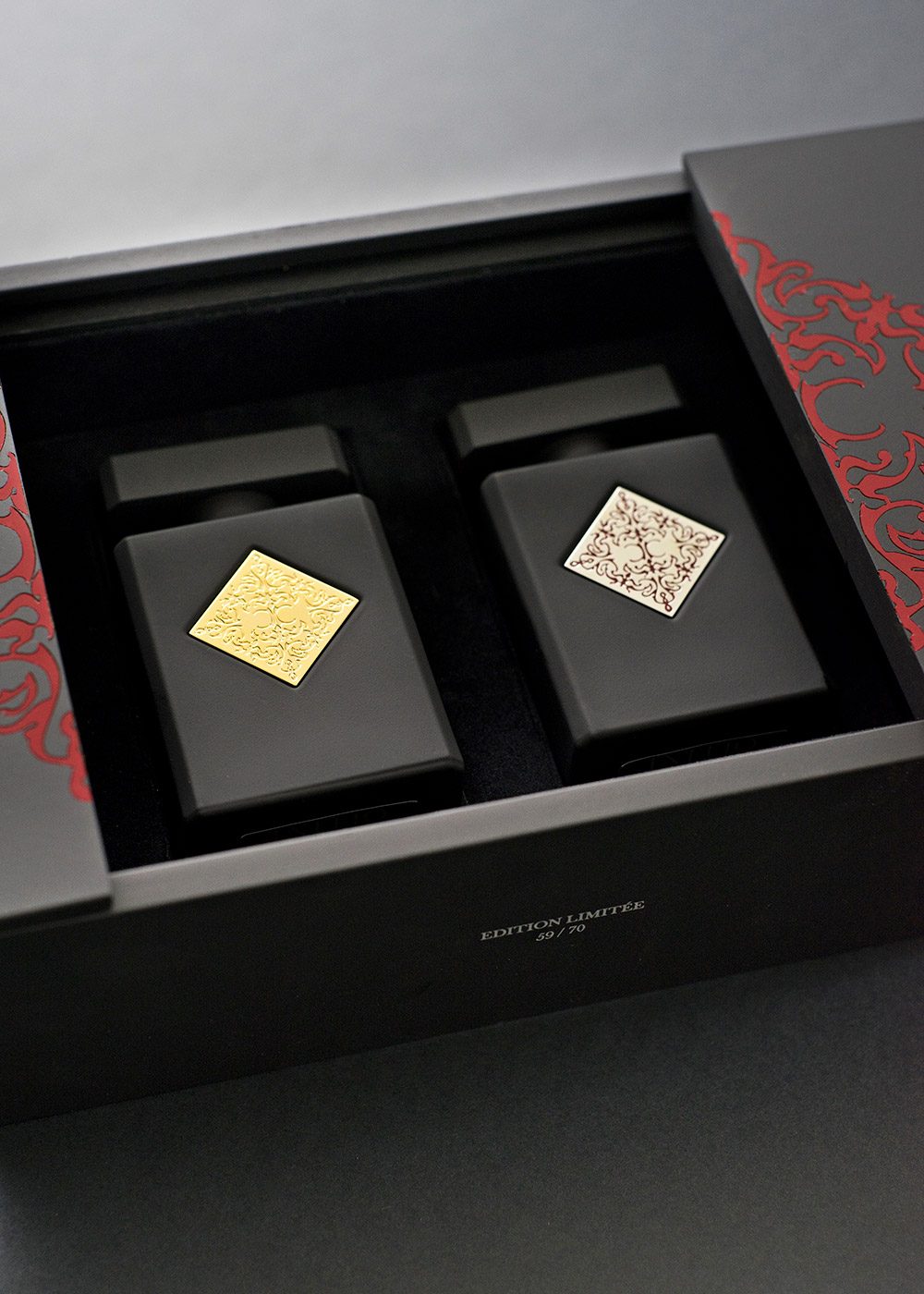
For Initio Parfums Privés, Iceberg designed a black gift box decorated with a red pattern, which opens onto two bottles nested in their insert.
For the Hydrafacial x JLo Beauty collaboration, Iceberg designed the packaging and an unboxing kit for influencers, in the powder-pink palette of the “Get ready to glow” campaign.
From packaging to point of sale
In perfumeries and department stores, the product sits alongside those of the greatest houses. It must be recognisable from a distance, and its universe must extend throughout the brand’s space: windows, display stands, corners, screens.
For Parfums de Marly, Iceberg rolled out the “Royal Essence” campaign in store, with light boxes, screens and corners. For Initio, the agency also supports the international communication strategy and rolls out the materials: print, web, film and merchandising.
Putting the packaging into images
Packaging also lives in photos: on the website, social media, posters. Its staging must extend its universe. For Dior, Iceberg staged the skincare jar among raw stones and volcanic rocks, in shades of grey and black. The images were created with the help of artificial intelligence, without a photo shoot or studio, under the agency’s art direction. Discover our approach to content creation with AI.
More responsible luxury packaging
Luxury does not escape environmental requirements. The European Packaging and Packaging Waste Regulation (PPWR), applicable since 12 August 2026, requires the weight and volume of packaging to be reduced to what is strictly necessary. By 2030, double walls, false bottoms and superfluous layers that only serve to make packaging look bigger will be banned, with some exceptions.
Recyclable materials, plastic-free inserts, a gift set beautiful enough to be kept: restraint can also become a sign of luxury.
The stages of a packaging project
- Start from the brand: its history, its codes, its positioning, its clientele. For a new brand, the identity is created at the same time as the packaging, as for Françoise Morice or Perfectha.
- Define the range and the formats: products, sizes, boxes, gift sets, limited editions.
- Explore creative routes: shapes, colours, typefaces, materials, presented on boards and in images.
- Choose the materials and finishes, with mock-ups and prototypes to judge how they feel in the hand.
- Oversee production: cutting dies, colours, mandatory information, proofs. Iceberg follows the whole process; manufacturing is entrusted to specialist partners.
- Launch the product: images, campaign, social media, unboxing kits and points of sale.
Frequently asked questions
What makes packaging luxurious?
Consistency with the house’s history, the quality of the materials and finishes, and the opening experience. Luxury packaging is kept, photographed and recognised without reading the brand name.
What is the difference between a box and a gift set?
The box protects a product and accompanies it on the shelf. The gift set brings together several products or creates a special edition: it is a more elaborate object, designed to be given and kept.
How long does it take to create packaging?
Generally allow one to two months. Iceberg then follows the whole manufacturing process, carried out by specialist partners.
Can luxury packaging be responsible?
Yes: less material, recyclable materials, no unnecessary volume. Since the European packaging regulation, it is also a gradual obligation.
Does Iceberg also create the brand identity?
Yes. For Maison Françoise Morice, the agency created the identity, the tagline “Sculpter la peau, naturellement” (Sculpting the skin, naturally), the packaging, the website and the brochure. For Perfectha, the identity, the packaging and a video campaign.
Launching a fragrance, a skincare product or a limited edition? Discover our approach to fragrance and beauty communication and luxury branding, or let’s talk about your project: yulia@iceberg.fr – +33 6 64 86 93 83.
115 rue du bac
75007 Paris - France
Aspin Commercial Tower, 41st Floor,
Office 4101-4104 Sheikh Zayed Road
P.O Box 72461, Dubai, U.A.E
- A Senior Project Manager
- An Art Director
- A Senior Graphic Designer / Creative
- A 3D Generalist
- A Web Developer
- A Community Manager (freelance)
- Interns: graphic design, project management, business development
+ 33 1 85 61 09 36
+ 33 1 85 61 09 36
+ 33 1 85 61 09 36
yulia@iceberg.fr
Contact Dubaï :
T. + 33 6 64 86 93 83
yulia@iceberg.fr

ICEBERG – LLC (Limited Liability Company - fifty thousand euros of capital)
RCS Paris B441 182 003
SIRET : 441 182 003 00034
115, rue du Bac - 75007 Paris
+33 (0)6 64 86 93 83
ice.info@iceberg.fr
Creation :
Iceberg.fr
Publication manager :
ICEBERG
115, rue du Bac - 75007 Paris
+33 (0)6 64 86 93 83
ice.info@iceberg.fr
Hosting :
SAS OVH
2, rue Kellermann - 59 100 ROUBAIX, France
+33 (0)8 99 70 17 61