
Generative AI for premium brands: creating images without a photo shoot
Premium brands need ever more images: social media, website, points of sale, international campaigns. Photo shoots remain long and costly: studio, models, sets, travel. Generative AI now makes it possible to produce credible images without any of that. But for a luxury brand, a bland or approximate image costs more than one image fewer.
Iceberg creates content with artificial intelligence for luxury and beauty houses such as Dior, Dolce&Gabbana and Hydrafacial x JLo Beauty, and for real estate projects such as 26 Madrid and Botanica. Here is what AI changes, what it does not change, and how to use it to serve a brand.
What AI changes in image production
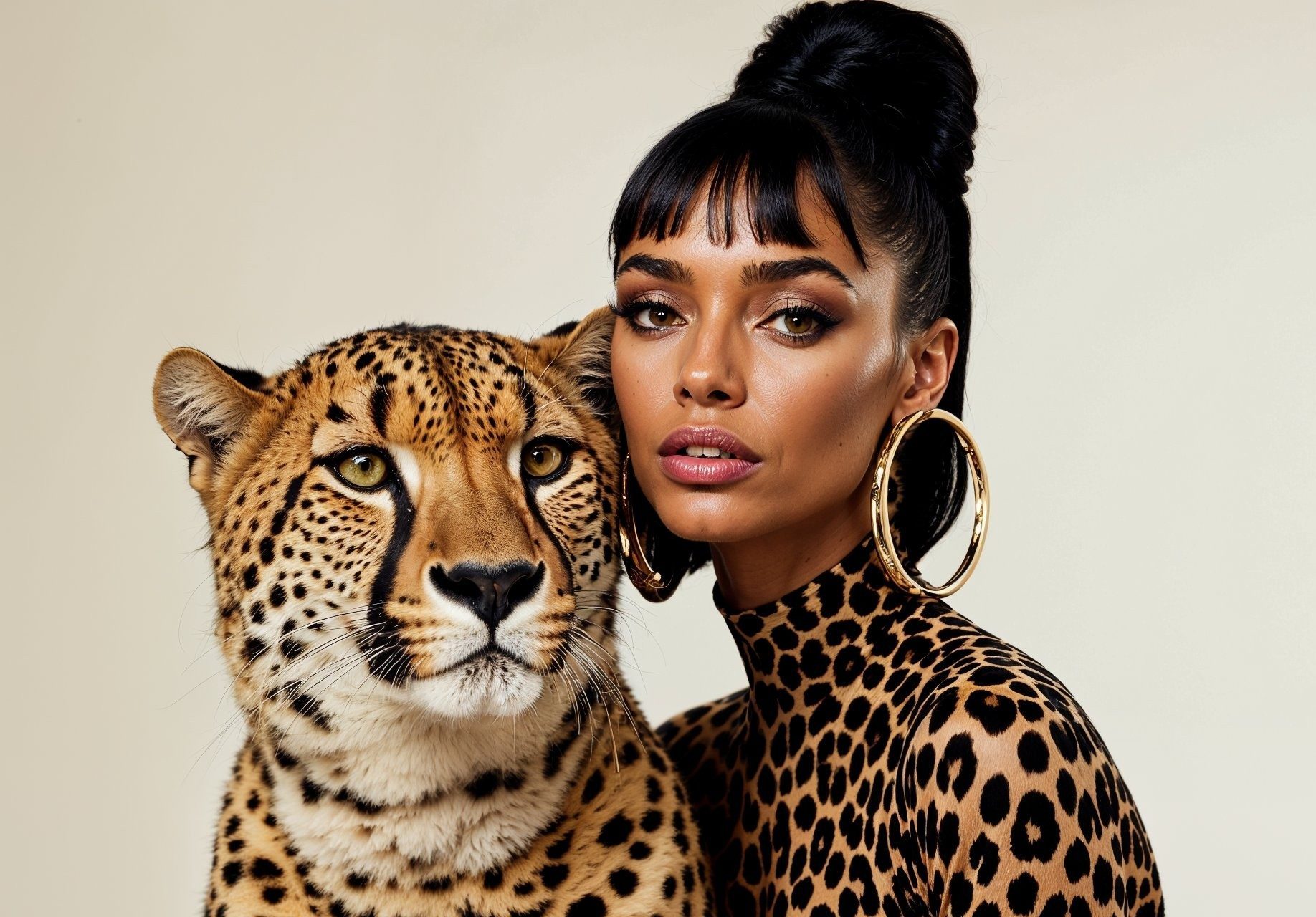
- Producing without a photo shoot. For the campaign for Dolce&Gabbana’s 2026 swimwear collection, Iceberg created images of models in leopard print alongside a cheetah, without any photo shoot.
- Staging a product. For Dior, the agency staged a skincare jar among raw stones and volcanic rocks, in shades of grey and black.
- Creating worlds that are hard to photograph. For Botanica, an office building in Luxembourg, the lush nature at the heart of the project’s identity was depicted with AI.
- Exploring quickly. Several creative routes can be tested and compared before production.
- Adapting. The same campaign can be adapted into formats for social media, print and digital. For Hydrafacial x JLo Beauty, AI supported the creation of the visuals and new formats for the “Get ready to glow” campaign. For 26 Madrid, the visuals created with AI were used on all the communication materials.
What AI does not replace
AI replaces what is expensive in image production: the photo shoot, the studio, the models, the sets. It replaces neither talent, nor creativity, nor art direction.
Without direction, an AI produces generic, already-seen images that look like no brand in particular. For a luxury house, that is the main risk: becoming commonplace. The idea, the universe, the choice of images and their consistency remain human work.
Points to watch
- Fidelity to the product. A bottle, a logo or a text must be exact. AIs often distort letters and small details: Iceberg starts from a photo of the real product or creates a 3D model of it, then checks and retouches each image.
- Brand consistency. The same light, the same palette and the same style must be found from one image to the next, and in the brand’s other materials.
- Rights. In France, an image generated entirely by AI, without human creative input, is in principle not protected by copyright. Art direction, selection and retouching therefore also matter legally. You must also avoid imitating a real person, a work or another brand.
- Transparency. Since 2 August 2026, the European regulation on AI (AI Act) requires certain AI-generated content to be disclosed, in particular realistic images of people, places or events that could pass for real. For a clearly creative work, the disclosure can remain discreet. In its case studies, Iceberg states when images were created with AI.
Iceberg’s method
- Define the universe from the brand’s identity: palette, light, materials, casting, references.
- Explore routes and present styleframes, key images that set the mood, to choose a direction with the brand.
- Produce from a photo of the product or its 3D model, with expert prompts and training targeted at the brand’s universe.
- Select and retouch: the chosen images are reworked by hand, down to the details of the product and the texts.
- Check every visual before delivery: quality, fidelity to the product, consistency with the brand identity.
- Adapt the images into production-ready formats: print, social media, film and 3D, points of sale.
Prices and lead times
At Iceberg, an image created with AI is generally produced in one to two days. Prices start at €1,500, depending on the difficulty of the request and the usage rights.
AI within a complete campaign
AI is rarely used on its own. At Iceberg, it is part of the Iceberg New Content IA division, which also produces films, 3D, 360° campaigns and social media content. For Hydrafacial x JLo Beauty, the visuals created with AI support a social media strategy, packaging and an unboxing kit for influencers. For a building, AI creates moods, but 3D remains the way to show the architecture faithfully: see our guide 3D films and renderings. For a luxury product, it extends the work of the packaging: see our guide Luxury packaging.
IA by Iceberg, the agency’s showcase, brings together examples of what AI makes possible: beauty and fashion portraits, luxury products and packaging, shop fronts, conceptual scenes and campaign visuals.
Frequently asked questions
Does AI replace a photo shoot?
It replaces the production, which is what is expensive: the photo shoot, the studio, the models, the sets. It does not replace talent, creativity or art direction.
How much does an image created with AI cost?
At Iceberg, from €1,500 per image, depending on the difficulty of the request and the usage rights, generally for one to two days of production.
Is an image created with AI protected by copyright?
In France, an image generated entirely by AI, without human creative intervention, is in principle not protected. Human creative choices, selection and retouching may be. The question has rarely been settled by the courts: for a major campaign, it is best to check with a lawyer.
Do you have to say that an image was created with AI?
The European regulation on AI requires it for certain content, in particular realistic images that could pass for real. Beyond the obligation, saying so protects trust in the brand.
Is AI suitable for a luxury brand?
Yes, provided it is directed. Used without art direction, it makes a brand’s image commonplace; when directed, it makes it possible to produce demanding images faster and to test more routes.
For which sectors?
Luxury, beauty, fashion and fragrance, but also real estate and corporate.
Want to create brand images with AI? Discover our approach to content creation with AI and luxury branding, or let’s talk about your project: yulia@iceberg.fr – +33 6 64 86 93 83.
115 rue du bac
75007 Paris - France
Aspin Commercial Tower, 41st Floor,
Office 4101-4104 Sheikh Zayed Road
P.O Box 72461, Dubai, U.A.E
- A Senior Project Manager
- An Art Director
- A Senior Graphic Designer / Creative
- A 3D Generalist
- A Web Developer
- A Community Manager (freelance)
- Interns: graphic design, project management, business development
+ 33 1 85 61 09 36
+ 33 1 85 61 09 36
+ 33 1 85 61 09 36
yulia@iceberg.fr
Contact Dubaï :
T. + 33 6 64 86 93 83
yulia@iceberg.fr

ICEBERG – LLC (Limited Liability Company - fifty thousand euros of capital)
RCS Paris B441 182 003
SIRET : 441 182 003 00034
115, rue du Bac - 75007 Paris
+33 (0)6 64 86 93 83
ice.info@iceberg.fr
Creation :
Iceberg.fr
Publication manager :
ICEBERG
115, rue du Bac - 75007 Paris
+33 (0)6 64 86 93 83
ice.info@iceberg.fr
Hosting :
SAS OVH
2, rue Kellermann - 59 100 ROUBAIX, France
+33 (0)8 99 70 17 61