
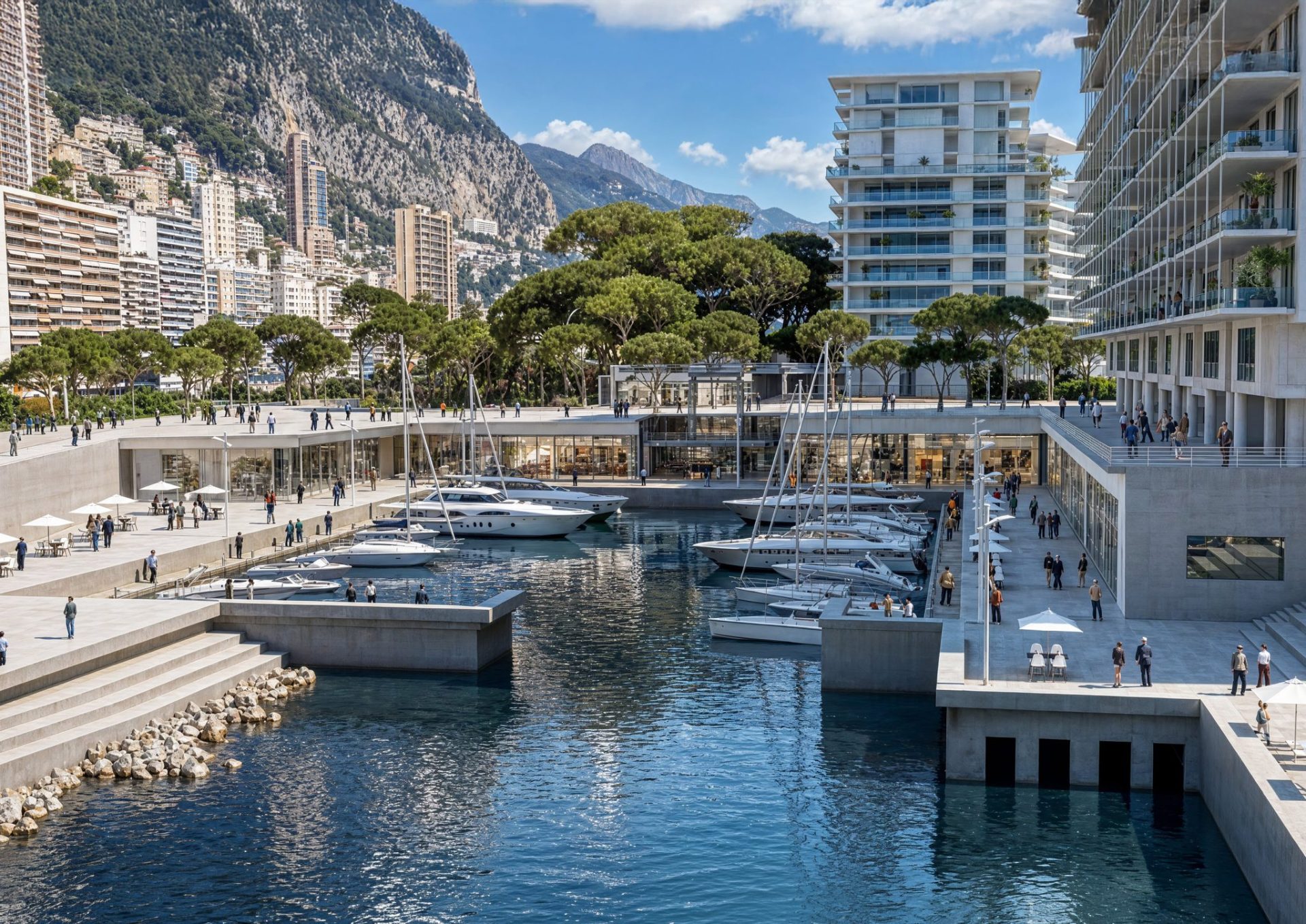
3D films and renderings: showing a real estate project before it is built
A real estate project is often marketed off-plan, sometimes years before delivery. To convince a company or an investor, you have to show them what does not exist yet: the light in a lobby, the view from a terrace, the life of a neighbourhood. That is the role of films and 3D images.
Iceberg produces them for office buildings, mixed-use projects and towers: the 3D film of 52 Champs-Élysées in Paris, that of HOPEN in La Défense, the images of the Anse du Portier – Mareterra in Monaco. Here is how to choose the right formats and how their production works.
Rendering, film, teaser: which format for which need?
- The 3D rendering is a still image that shows a space from a chosen angle: a façade, a lobby, a restaurant. For 4 Général Foy, Iceberg produced the renderings of the entrance hall, the lobby and the restaurant. It is used in the brochure, on the website and on the hoardings.
- The 3D film takes viewers through the building and its neighbourhood, with a narrative: the arrival, the lobby, the floors, the terraces. This is the format of the HOPEN film.
- The teaser, shorter, announces the project and arouses curiosity before the leasing campaign is launched, like those for 52 Champs-Élysées, La Poste du Louvre and Carré Concorde.
- The brand film conveys the spirit of the place rather than its plans: the film “Authentique” for 26 Madrid, the film for Kennedy in Paris 16th.
- Interactive experiences let visitors explore at their own pace: the 360° axonometric view on the HOPEN website, the interactive plans and renderings for 4 Général Foy, the virtual tour of Mille Arbres.
What 3D brings to leasing
- Picturing the spaces before delivery. Companies see the spaces as they will be delivered, well before the works are finished.
- Telling the project’s story. The film showcases the architecture, the services and the neighbourhood, in line with the building’s identity.
- Feeding every medium. The same set of images is used on the website, social media, the brochure and the hoardings, in the marketing suite and in investor presentations.
- Carrying major projects internationally. For Jeddah Tower, in Saudi Arabia, Iceberg worked alongside Valode et Pistre on the 3D renderings of the architecture and of the Kingdom Mall interiors. The agency also produced the film and 3D for Al Noor Tower, for Jeddah Economic Company.
The stages of producing a 3D film
At Iceberg, films and 3D are produced in-house, by the agency’s team, in six stages.
- Start from the building’s story. The film extends its name, tagline and visual identity. Our guide Naming and branding an office building details this stage.
- Gather the project data: the architect’s plans, digital model, materials, interior and landscape design.
- Write the script and choose the moments to show: the arrival in the neighbourhood, the lobby, a floor, a terrace, a service.
- Model and light the building, its materials, its furniture and its uses.
- Approve key images before animation, to agree on the mood and the viewpoints.
- Animate, edit and adapt: full film, teaser, short versions for social media, still renderings for the brochure.
Prices and lead times
A real estate 3D film generally costs between €15,000 and €80,000. A 3D rendering costs between €1,200 and €2,300. The difference depends on the length of the film, the number of viewpoints, the level of detail and the variations requested.
Allow from two weeks to two months of production, depending on the number of images and the length of the film.
3D and artificial intelligence
Artificial intelligence complements 3D: it makes it possible to create moods and visuals for social media or the brochure. Iceberg used AI to create visuals for all the 26 Madrid materials, and to depict the lush nature of Botanica, in Luxembourg. 3D remains the way to show the architecture and the spaces faithfully. Discover our approach to content creation with AI.
Images ready from the start of the leasing campaign
The images must be available for the very first materials: hoardings, website, brochure. They then support every stage, through to the viewings. In a marketing suite, the film and renderings help brokers present spaces that are still under construction. See our guide Marketing suite or showroom.
Frequently asked questions
What is the difference between a 3D rendering and a 3D film?
A rendering is a still image that shows a space from a chosen angle: a lobby, a façade, a restaurant. A 3D film takes viewers through the building and its neighbourhood, with a narrative.
Can a building still under construction be presented?
Yes, it is the most common case: 3D shows the spaces as they will be delivered, well before the works are finished.
Does every project need a film?
Not always. A few well-chosen renderings are often enough for a medium-sized building. A film is justified when the project has a route to show, a neighbourhood to reveal or international ambitions.
Where are films and 3D used?
On the project website and social media, in brochures, on hoardings, in the marketing suite and in investor presentations.
Preparing to market a project? Discover our work in real estate film and 3D, or let’s talk about your project: yulia@iceberg.fr – +33 6 64 86 93 83.
115 rue du bac
75007 Paris - France
Aspin Commercial Tower, 41st Floor,
Office 4101-4104 Sheikh Zayed Road
P.O Box 72461, Dubai, U.A.E
- A Senior Project Manager
- An Art Director
- A Senior Graphic Designer / Creative
- A 3D Generalist
- A Web Developer
- A Community Manager (freelance)
- Interns: graphic design, project management, business development
+ 33 1 85 61 09 36
+ 33 1 85 61 09 36
+ 33 1 85 61 09 36
yulia@iceberg.fr
Contact Dubaï :
T. + 33 6 64 86 93 83
yulia@iceberg.fr

ICEBERG – LLC (Limited Liability Company - fifty thousand euros of capital)
RCS Paris B441 182 003
SIRET : 441 182 003 00034
115, rue du Bac - 75007 Paris
+33 (0)6 64 86 93 83
ice.info@iceberg.fr
Creation :
Iceberg.fr
Publication manager :
ICEBERG
115, rue du Bac - 75007 Paris
+33 (0)6 64 86 93 83
ice.info@iceberg.fr
Hosting :
SAS OVH
2, rue Kellermann - 59 100 ROUBAIX, France
+33 (0)8 99 70 17 61